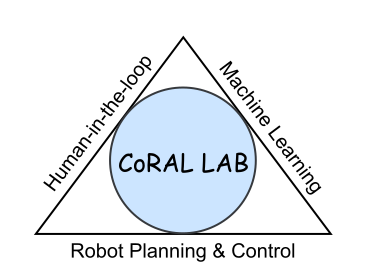
I am an Assistant Professor in the Department of Computer Science at Purdue University, where I direct the Cognitive Robot Autonomy and Learning (CoRAL) Lab. I am also affiliated with the Institute for Control, Optimization and Networks (ICON). I earned my Ph.D. from the University of California San Diego, and I hold an M.S. from Osaka University and a B.S. in Electrical Engineering from the National University of Sciences and Technology.
My research develops structured learning frameworks for robot planning and control, treating physical and formal structure, rather than data scale alone, as a primary inductive bias for robot learning. My group embeds physics, such as Hamilton-Jacobi and Eikonal PDE structure, and formal constraints, such as reachability and safety specifications, directly into learning, so that robots can learn from limited demonstration or trial-and-error interaction and plan rapidly and reliably in complex, challenging environments. Our work spans robot motion planning, manipulation, navigation, multi-robot coordination, and assistive robotics.
My group publishes at leading robotics and machine-learning venues, including IEEE Transactions on Robotics, IEEE Robotics and Automation Letters, RSS, ICRA, IROS, ICLR, NeurIPS, and CoRL. I have received several awards, including the NSF CAREER Award and the Samsung LEAP-U Award; paper recognition such as an Honorable Mention for the IEEE Transactions on Robotics King-Sun Fu Memorial Best Paper Award; and the Robotics and Automation Letters Outstanding Associate Editor Award (2024). I am also an IEEE Senior Member.
I contribute to the robotics community through editorial and program leadership. I have served as an Associate Editor for IEEE Transactions on Robotics and IEEE Robotics and Automation Letters, and I have held senior program committee roles for RSS, CoRL, ICRA, and IROS.
Our aim is to develop biologically inspired, general-purpose reasoning, planning, and control algorithms for physical, compliant and safe human-robot collaboration in the real, dynamic environments. This research direction is conined as Collaborative Planning and Control, where human biomechanical and cognitive behavior models are taken explicitly into account for decision-making and control.
My team at CoRAL Lab performs fundamental research in the area of Collaborative Planning and Control, where human biomechanical and cognitive behavior models are taken explicitly into account for robots' decision-making and control. Our work aligns closely with the industry for solving a wide range of collaborative, multi-agent, robotics and autonomous driving problems in the natural dynamic world. Our work aligns closely with the industry for solving a wide range of collaborative, multi-agent, robotics and autonomous driving problems in the natural dynamic world.
If you have an idea or are interested in collaboration, please contact us.
Prospective Students
We are actively looking for students/scholars at all levels (BS/MS/PhDs/Post-docs) with a strong relevant background in Robotics, Machine Learning, and Computer Vision. If you are interested in working with me, please fill out this form. Non-Purdue students who are seeking M.S./Ph.D. positions will have to apply online through the PurdueCS admission portal and mention Prof. Ahmed H. Qureshi as a potential advisor.